
Import Export Trade Basics
The world of Import Export Trade can feel like stepping into a maze filled with confusing terms, shipping documents, and endless abbreviations. If you’ve ever searched for terms like FOB, CIF, or EXW and ended up more confused than before, you’re not alone.
These three terms are among the most commonly used shipping agreements in international business. Whether you’re working with a global sourcing company, dealing with a wholesale supplier, or planning to import from China, understanding these trade terms is essential.
Think of these terms like the rules of a road trip. They determine who drives, who pays for fuel, who handles problems on the road, and where responsibility changes hands.
Let’s break everything down in the simplest possible way.
What Are Incoterms in Import Export Trade?
Incoterms stand for “International Commercial Terms.” They are globally accepted trade rules created by the International Chamber of Commerce (ICC).
These rules explain:
- Who pays for shipping
- Who arranges transportation
- Who handles insurance
- Who manages customs clearance
- When risk transfers from seller to buyer
Without Incoterms, international shipping would be chaotic. Imagine buying goods overseas without knowing who is responsible if cargo gets damaged halfway through the journey.
That’s where FOB, CIF, and EXW come in.
Why Incoterms Are Important for Buyers and Sellers in Import Export Trade
In Import Export Trade, misunderstandings can cost thousands of dollars. Incoterms help prevent disputes by clearly defining responsibilities.
For example:
- A freight forwarding company needs to know who books cargo space.
- A sourcing agent must understand who handles pickup.
- A customs clearance team needs clarity on shipping ownership.
Clear trade terms create smoother transactions, faster deliveries, and fewer headaches.
What is FOB in Import Export Trade?
FOB stands for “Free On Board.”
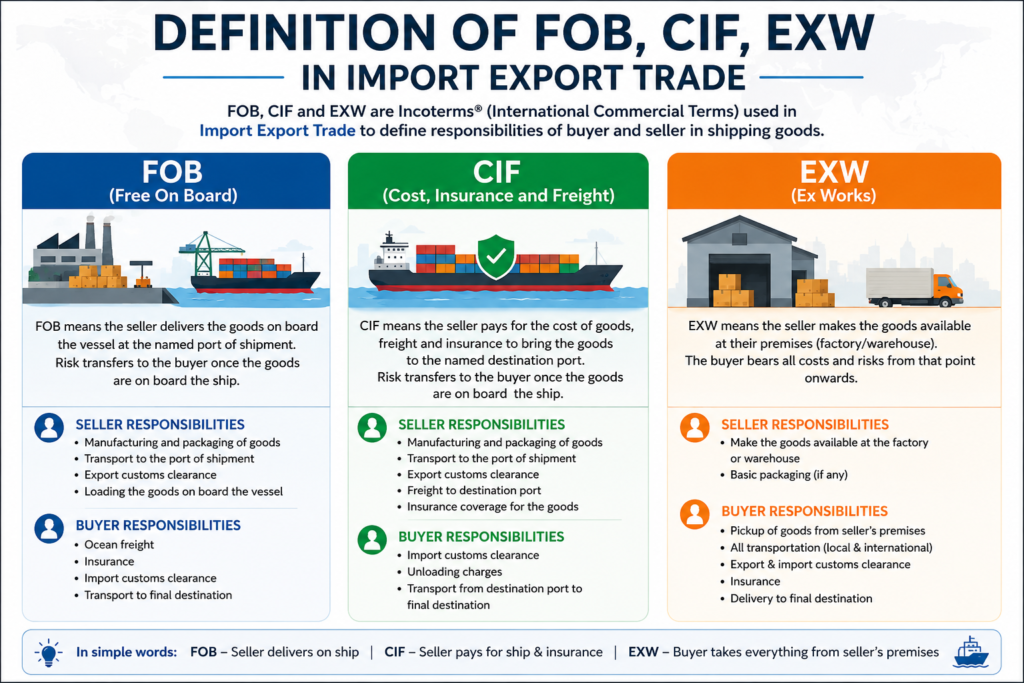
Under FOB terms, the seller is responsible for delivering goods to the shipping port and loading them onto the vessel. Once the goods are onboard, responsibility transfers to the buyer.
It’s one of the most popular terms in international shipping.
How FOB Works
Here’s a simple example.
Suppose you buy furniture from a bulk products supplier in China.
Under FOB:
Seller Responsibilities in Import Export Trade
- Manufacturing goods
- Packaging products
- Transporting goods to the port
- Export customs clearance
- Loading cargo onto the ship
Buyer Responsibilities
- Ocean freight costs
- Insurance
- Import customs clearance
- Delivery to final destination
Once the cargo is on the ship, the buyer takes responsibility.
Think of it like handing over a relay baton during a race.
Advantages of FOB in Import Export Trade
FOB is popular because it offers balance.
Better Cost Control
Buyers can choose their own freight forwarding company and negotiate shipping rates.
Transparency
Costs are usually easier to understand compared to bundled pricing.
Ideal for Experienced Importers
Businesses with strong logistics solutions often prefer FOB.
What is CIF in Import Export Trade?
CIF stands for “Cost, Insurance, and Freight.”
Under CIF, the seller handles more responsibilities compared to FOB.
The seller pays for:
- Shipping
- Insurance
- Freight charges until the goods reach the destination port
However, ownership risk still transfers to the buyer once goods are loaded onto the vessel.
Sounds strange, right? The seller pays, but the risk shifts early. That’s why understanding details matters.
How CIF Shipping Works in Import Export Trade
Let’s imagine you’re buying electronics from a China sourcing company.
Under CIF:
Seller Handles
- Product manufacturing
- Export packaging
- Freight booking
- Shipping costs
- Marine insurance
Buyer Handles
- Import duties
- Local transportation
- Customs clearance at destination
CIF is often preferred by beginners because it simplifies the shipping process.
Advantages and Disadvantages of CIF in Import Export Trade
Advantages
- Easier for new importers
- Seller manages shipping
- Convenient for small businesses
Disadvantages
- Less control over shipping companies
- Hidden shipping costs may exist
- Insurance coverage may be minimal
Many importers eventually move from CIF to FOB once they gain experience.
What is EXW in Import Export Trade?
EXW stands for “Ex Works.”
This term gives maximum responsibility to the buyer.
The seller only makes the goods available at their factory or warehouse. Everything after that is handled by the buyer.
In simple words: “Come pick up your goods.”
How EXW Works in International Shipping
Suppose you purchase garments from a wholesale supplier in Guangzhou.
Under EXW:
Seller Responsibilities
- Prepare products
- Package goods
Buyer Responsibilities
- Pickup from supplier warehouse
- Truck transportation
- Export customs
- Freight forwarding
- Insurance
- Import customs clearance
- Final delivery
EXW offers maximum control but also maximum responsibility.
Benefits and Risks of EXW in Import Export Trade
Benefits
- Lowest supplier pricing
- Full shipping control
- Flexible logistics planning
Risks
- Complex for beginners
- Requires reliable import export services
- Buyer handles almost everything
EXW works best for experienced importers with trusted shipping partners.
FOB vs CIF vs EXW
Now let’s compare them side by side.
| Feature | FOB | CIF | EXW |
| Seller Handles Shipping | Partial | Yes | No |
| Seller Handles Insurance | No | Yes | No |
| Buyer Control | Medium | Low | High |
| Best for Beginners | Yes | Yes | No |
| Shipping Cost Transparency | High | Medium | High |
| Customs Clearance | Shared | Shared | Buyer |
Each option fits different business needs.
Which Incoterm is Best for Beginners?
If you’re new to Import Export Trade, CIF is usually the easiest starting point.
Why?
Because the seller handles most shipping arrangements.
However, once you gain experience, FOB often becomes more cost-effective and transparent.
EXW is generally recommended only when:
- You have a trusted freight forwarding network
- You work with experienced trade consulting experts
- You already understand customs procedures
Role of Freight Forwarding in Import Export Services
A freight forwarding company acts like a travel agent for cargo.
They coordinate:
- Shipping routes
- Documentation
- Customs clearance
- Warehousing
- Delivery schedules
Without proper freight forwarding, even small shipping mistakes can create massive delays.
Reliable logistics solutions are the backbone of successful international trade.
How a Global Sourcing Company Helps
A global sourcing company helps businesses find reliable suppliers worldwide.
Their services often include:
- Supplier verification
- Factory audits
- Price negotiation
- Product inspections
- Shipping coordination
This is especially useful when planning to import from China.
China remains one of the world’s largest manufacturing hubs, but finding trustworthy suppliers can be challenging without local expertise.
Import from China Made Easy
Many businesses source products from China because of:
- Competitive pricing
- Massive product variety
- Scalable manufacturing
However, importing isn’t just about finding cheap products.
Successful B2B sourcing requires:
- Product quality checks
- Supplier verification
- Clear contracts
- Reliable shipping partners
Working with a trusted sourcing agent reduces risks dramatically.
UAE Import Company and Saudi Arabia Wholesale Market Opportunities
The Middle East has become a major trade hub.
A reliable UAE import company can help businesses access:
- Dubai free zones
- Global shipping routes
- Fast customs processing
Meanwhile, the Saudi Arabia wholesale market is growing rapidly due to:
- Infrastructure development
- Retail expansion
- Increasing consumer demand
Businesses involved in export business activities are increasingly targeting Gulf markets for expansion.
Customs Clearance and Logistics Solutions
One delayed customs document can stop an entire shipment.
That’s why customs clearance is one of the most critical parts of international trade.
Professional import export services help businesses manage:
- Import duties
- Tax documentation
- Compliance regulations
- Port inspections
Efficient logistics solutions keep cargo moving smoothly across borders.
Importance of Trade Consulting
Would you try climbing Mount Everest without a guide?
That’s what international trade can feel like without expert support.
Trade consulting services help businesses:
- Understand shipping regulations
- Choose the best Incoterms
- Reduce import costs
- Avoid legal issues
Consultants can save companies enormous amounts of time and money.
Tips for Choosing a Wholesale Supplier
Not all suppliers are equal.
A good wholesale supplier should offer:
- Consistent quality
- Transparent pricing
- Fast communication
- Verified certifications
Before placing large orders:
- Request samples
- Conduct supplier verification
- Check export history
- Use third-party inspections
A reliable bulk products supplier becomes a long-term business partner, not just a vendor.
Common Mistakes in Import Export Trade
Even experienced traders make mistakes.
Here are common errors to avoid:
Ignoring Shipping Terms
Misunderstanding FOB, CIF, or EXW can create surprise expenses.
Skipping Supplier Verification
Fraudulent suppliers still exist in global trade.
Choosing Cheap Freight Only
Low-cost shipping sometimes means poor service and delays.
Incorrect Customs Documentation
Small paperwork errors can result in fines or shipment holds.
Not Using Insurance
Cargo damage happens more often than many businesses realize.
Avoiding these mistakes can protect profits and business reputation.
The Future of Import Export Trade
Technology is transforming global commerce faster than ever.
Modern businesses now use:
- AI-powered sourcing platforms
- Digital customs systems
- Real-time cargo tracking
- Automated supplier verification
As eCommerce grows globally, demand for smarter import export services will continue increasing.
Businesses that understand shipping terms and build strong logistics networks will stay ahead of competitors.
Conclusion
Understanding FOB, CIF, and EXW is essential for anyone entering the world of Import Export Trade.
These shipping terms determine who pays, who manages shipping, and who carries the risk during transportation.
Here’s the simple breakdown:
- FOB offers balanced responsibility
- CIF provides convenience for beginners
- EXW gives buyers maximum control
Whether you work with a global sourcing company, manage international shipping, or plan to import from China, choosing the right Incoterm can significantly impact costs, efficiency, and profitability.
International trade may seem complicated at first, but once you understand these fundamentals, the entire process becomes much easier to navigate.
FAQs
1. Which is better: FOB or CIF?
FOB is usually better for experienced importers because it offers more control over shipping costs. CIF is easier for beginners since the seller arranges transportation.
2. Is EXW cheaper than FOB?
EXW often has lower product pricing because the seller has fewer responsibilities. However, buyers may face higher logistics costs overall.
3. What does a freight forwarding company do?
A freight forwarding company manages cargo transportation, shipping documents, customs clearance, and delivery coordination.
4. Why is supplier verification important in B2B sourcing?
Supplier verification helps confirm that a factory or supplier is legitimate, reliable, and capable of meeting quality standards.
5. Can a sourcing agent help with importing from China?
Yes. A sourcing agent can help find suppliers, negotiate pricing, inspect products, and coordinate shipping for safer and smoother importing.