
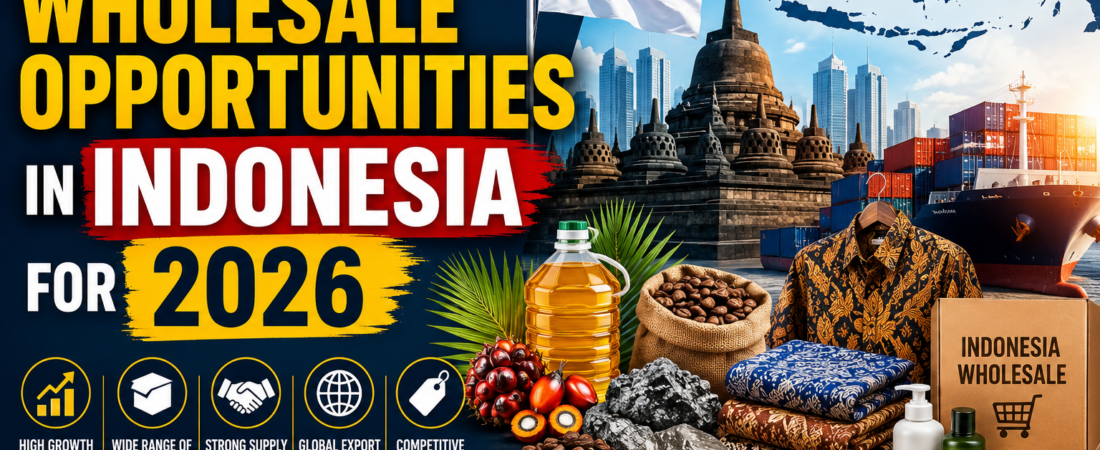
Unlock Indonesia’s Fast-Growing Wholesale Market in 2026
Indonesia is entering a new era of commodity-driven expansion, export restructuring, and digital trade growth, making it one of the most attractive wholesale sourcing hubs in Asia.
From agriculture and raw materials to manufacturing and consumer goods, Indonesia offers strong supply chains, competitive pricing, and export-ready industries.
👉 Start sourcing smarter. Scale faster. Tap into Indonesia’s wholesale ecosystem.
Why Indonesia for Wholesale in 2026?
Indonesia remains a global powerhouse in key export sectors such as palm oil, minerals, textiles, and manufactured goods. Recent policy shifts toward stronger state control of commodity exports and downstream processing are also reshaping opportunities for traders and wholesalers.
Key advantages:
- Abundant natural resources (palm oil, coal, nickel)
- Rapid growth in manufacturing and EV supply chains
- Large domestic production base
- Competitive labor and production costs
- Expanding export infrastructure and logistics hubs
Top Wholesale Opportunities in Indonesia (2026)
1. Agricultural & Food Commodities
Indonesia is one of the world’s largest exporters of palm oil and spices, with strong global demand from food, cosmetics, and biofuel industries.
Best products:
- Palm oil & derivatives
- Coffee (Arabica & Robusta)
- Cocoa
- Spices (clove, vanilla, nutmeg)
- Coconut-based products
💡 Why it works: High global demand + stable export markets + scalable sourcing from rural producers.
2. Minerals & Industrial Raw Materials
Indonesia is rapidly expanding its role in global mineral supply chains, especially in nickel and steel-related industries.
Best products:
- Nickel ore & processed nickel
- Iron & steel products
- Coal (thermal & industrial)
- Tin & bauxite
💡 Why it works: Strong government support for downstream processing and global demand from EV and energy sectors.
3. Manufacturing & Light Industry Goods
Indonesia’s manufacturing sector is growing due to domestic demand and export diversification.
Best products:
- Automotive components
- Electronics assembly parts
- Furniture (teak, rattan)
- Household goods
- Packaging materials
💡 Why it works: Low production costs + increasing export competitiveness in Asia-Pacific markets.
4. Textile & Fashion Wholesale
Indonesia is a major producer of batik, woven textiles, and apparel manufacturing.
Best products:
- Batik fabrics & garments
- Cotton clothing
- Workwear & uniforms
- Export-ready fashion items
💡 Why it works: Strong craftsmanship + global demand for ethical and handcrafted textiles.
5. Consumer Wholesale & FMCG Distribution
Fast-moving consumer goods are expanding due to Indonesia’s large population and retail modernization.
Best products:
- Packaged food products
- Beverages
- Personal care items
- Household essentials
💡 Why it works: Huge domestic consumption base + stable repeat demand.
Emerging Trends in 2026
- 🇮🇩 Export centralization reforms reshaping commodity trade flows
- ⚡ Growth of nickel-driven EV supply chains
- 🌱 Increased demand for sustainable and certified products
- 📦 Expansion of B2B digital wholesale platforms
- 🚢 Stronger logistics integration across ASEAN
Challenges to Consider
- Regulatory changes in export policies
- Price volatility in commodities
- Supply chain fragmentation in rural sourcing
- Strong competition from established trading firms
- Logistics and compliance complexity
How to Start a Wholesale Business in Indonesia
- Identify high-demand commodity or product category
- Build supplier relationships (farmers, factories, cooperatives)
- Set up legal entity (PT or export trading company)
- Secure export/import compliance documentation
- Establish buyer channels (China, Middle East, EU, ASEAN)
- Scale through brokers or direct contracts
Final Takeaway
Indonesia in 2026 is not just a sourcing destination it is becoming a strategic global supply hub for commodities, manufacturing, and processed exports.
If you position correctly, the biggest opportunities lie in:
- Commodities with global demand (palm oil, nickel, coffee)
- Export-linked manufacturing
- Value-added processing industries